
How to – Fix the Vicidial error: Code Expects Different Schema

 

How to – Fix the Vicidial error: Code Expects Different Schema

different schema

How to – Fix the Vicidial error: Code Expects Different Schema

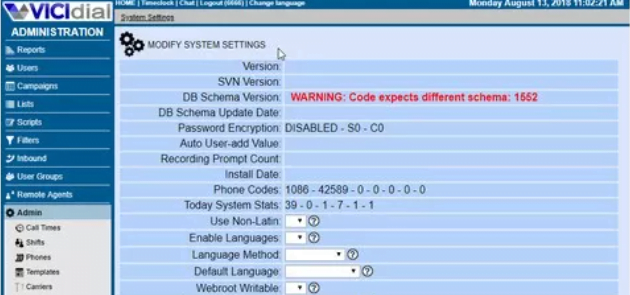
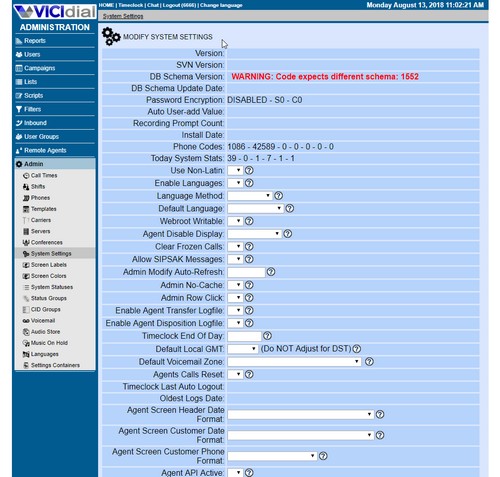
This is a pretty easy fix, “Code Expects Different Schema” occurs when you update your svn version but forget to update the db schema through mysql. The instructions are below.
Vicidial-warning-code-expects-different-schema

After database dump restoration taken from older Vicibox to the latest Vicibox 9.0.3 I got the following error in Admin -> System Settings section:

WARNING: Code expects different schema: 1585

It’s not possible to change or save any setting. The reason is obvious: Vicibox 9 has new and altered tables and functions so you will have to add them to the restored database before you can use system.

First, confirm your current database schema version. Log in to MariaDB command prompt and perform the following query:

1MariaDB> SELECT db_schema_version FROM system_settings;

Next, navigate to /usr/src/astguiclient/trunk/extras folder and locate upgrade_X.XX.sql files. Open the newest file and if it contains this schema version – this is the one that needs to be executed. In case you found your DB schema version not in the newest .sql , execute it first and then all newer files.

Please make note that some tables and functions may already exist in your database that’s why add -f key to the mysql command:

1# mysql -u root -f asterisk < /usr/src/astguiclient/trunk/extras/upgrade_2.14.sql

Confirm your current database schema version again and make sure it’s been upgraded.

Now you should be able to use the system and change/set settings.

I hope this helps

Comments

Popular posts from this blog

Install OpenVPN 2.4 and 2.6 on Alma / Rocky Linux

 To install OpenVPN on AlmaLinux 9.5, you can follow these steps: 1. Update the System : Before installing any software, it's a good idea to update your system: sudo dnf update -y 2. Install EPEL Repository : OpenVPN is available in the EPEL (Extra Packages for Enterprise Linux) repository. First, install the EPEL repository: sudo dnf install epel-release -y 3. Install OpenVPN : After enabling the EPEL repository, install OpenVPN: sudo dnf install openvpn -y 4. Install NetworkManager (Optional) : If you are using NetworkManager for managing network connections, you can install the OpenVPN plugin for NetworkManager: sudo dnf install NetworkManager-openvpn -y 5. Configure OpenVPN : Once installed, you need to configure OpenVPN by copying your .ovpn configuration file to the /etc/openvpn/ directory: sudo cp /path/to/your/config.ovpn /etc/openvpn/ 6. Start OpenVPN : You can start OpenVPN by specifying the configuration file directly: sudo openvpn --config /etc...

Vicidial Scratch installation Alma -9/10

Step 1 – Download the dependencies   hostnamectl set-hostname xxxxxx.xxxxx.xxx ### Use YOUR SubDomain vi /etc/hosts ##Change domain name for actual server ip (xxx.xxx.xxx.xxx   complete domain name    subdomain only) timedatectl set-timezone Asia/Kolkata yum check-update yum update -y yum -y install epel-release yum update -y yum install git -y yum install -y kernel* sudo dnf install kernel-devel-$(uname -r) -y # Install english language pack dnf install -y glibc-langpack-en # Configure new locale. This basically just edits /etc/locale.conf localectl set-locale en_US.UTF-8 #Disable SELINUX sed -i 's/SELINUX=enforcing/SELINUX=disabled/g' /etc/selinux/config     reboot Step 2 – Run the Script cd /usr/src/ git clone https://github.com/manish23k/vicidial-install-scripts cd vicidial-install-scripts ####For PHP 7.4 use this script. chmod +x alma-rocky9-ast16.sh ./alma-rocky9-ast16.sh Or the Asterisk 18 version: chmod +x alma-rocky9-ast18.sh ./alma-rock...

How to Format and Mount a New 1TB HDD

🖥 How to Format and Mount a New 1TB HDD to /var/www/recordings on Linux If you’ve added a new HDD to your Linux server and want to use it as a dedicated storage location — for example, to store Asterisk or web server recordings — you’ll need to partition, format, mount, and configure it to auto-mount at boot . In this guide, we’ll walk through the process of wiping the drive (careful — data will be lost!), creating a single ext4 partition , and mounting it permanently. Step 1: Identify Your New Disk Run: lsblk Example output: NAME MAJ:MIN RM SIZE RO TYPE MOUNTPOINTS sda 8 : 0 0 931.5 G 0 disk ├─sda1 8 : 1 0 50 M 0 part ├─sda2 8 : 2 0 540.8 G 0 part └─sda3 8 : 3 0 390.6 G 0 part In our case, /dev/sda is the new 1TB disk. ⚠ Warning: Double-check you’ve picked the right disk! Formatting the wrong one will destroy data. Step 2: Unmount Any Mounted Partitions sudo umount /dev/sda* 2>/dev/null Step 3: Wipe Old Partitions and Create One ...